HBO · Released
- 1Cannes-winning film
- 20Project slate built from nothing
- $1B+TOTAL BUDGETS OF FUNDED PROJECTS
- 15Countries shot across
- 3×$200M+ projects released







Filter tracks
Open or print the full landscape Atlas →
Key art in progress. These are typographic placeholders, not the finished posters.
Warner Bros. · Released
Jupiter AscendingThe Wachowskis
Netflix · Released
Sense8Season 1
Netflix · Released
Sense8Season 2 · Christmas special
Amazon Studios · Development
Tong WarsWong Kar Wai
Netflix · Released
Sense8Finale film
Amblin · Amazon · Development
Cortés / MexicaZaillian · Bardem
Warner Bros. · Released
The Matrix ResurrectionsWachowski · McTeigue
Amazon Studios · Development
The Condor YearsPadilha · Narcos team
MrBeast Studio
Keanu × MrBeastCharity video
Technology · Education
Word DogVideo assembly & distribution platform
Major studio pitches
OtherworldBoJack · Futurama team
Independent · Festival release
Agnes Wakes Up30+ festivals
Major studio pitches
A Christmas CarolJeff Buhler
Profile
Trained on ambitious productions
Neil’s career was built at the intersection of story, packaging, international relationships and the practical realities of getting ambitious work made.
Trained under Grant Hill
From 2014 to 2019, Neil learned beside the producer behind Titanic, The Thin Red Line, the Matrix sequels, V for Vendetta and Cloud Atlas -- experience that prepared him to become the first Head of Film & Television Development in the company’s history.
Neil learned how ambitious work gets made by standing close to people who had already made the impossible routine. His 30-plus film and television credits include global productions like The Matrix Resurrections and Netflix’s Sense8, whose filming spanned five continents and 37 units. Across work with Terrence Malick, Wong Kar Wai and the Wachowskis from 2014 through 2019 as Grant Hill’s assistant, he learned to separate the urgent problem from the important one.
Grant noticed that Neil had a knack for making every draft better. After chasing the Hotel Carnival lead himself, Neil helped turn one conversation into a unified creative team and director attachment, then independently secured a Netflix pitch meeting. Together with Neil’s contribution to getting Cortés greenlit, those two milestones propelled him into the full scope of the company’s first Head of Film & Television Development role and unlocked the next chapter of his career.
Neil built and ran that development effort while continuing to support the principal producer’s office behind two major productions running simultaneously. Grant’s mandate was explicit: development could never distract from those productions. So the slate stayed confidential and the work moved quietly around the productions already under way.
A confidential slate built inside the principal producer’s office
With direct access to Grant and broad creative latitude, but no dedicated development budget, Neil built a film and television slate that reached roughly 20 projects at its peak. He advanced projects through development, packaging, attachments and marketplace conversations with Village Roadshow, Amazon, True North, Netflix, 87West, 87North, CAA, WME and others, and led the slate presentation to Village Roadshow chairman Bruce Berman.
Neil identified the bilingual-series gap left by Narcos ending and partnered with its executive producer and pilot director, as well as Brazil’s highest-grossing feature team, to build a new IP from an award-winning investigative journalist — work that would earn him a promotion to Producer from Grant. This project continued after Elizabeth Bay. Neil produced, co-wrote, and developed the material with the team, then led outreach and wrangled the agency interest, resulting in a major CAA package, pitches around town, and an upgrade from series to feature film trilogy development at Amazon. Since 2023, Neil has worked independently across producing, directing, development and advising.
METHODOLOGY · Story Development
Better every draft.
Development work varies a lot, because every project is unique.
I identify the areas that help a project land the way it wants to, then work it out with the creator from there.
Drama and structure first.
Most projects share the same early challenge: distilling the drama. Past that, it's knowing each genre, audience expectations, and how to both fulfill and subvert them.
My favorite analogy: If the bike has a broken wheel, no matter how great the paint job, it'll never go. I make sure the wheels work so the details shine.
Whatever the project needs.
I aim to match the blood, sweat and tears of the creators who pour their whole world into a project; to be the best sounding board, to know every character and every change through every iteration. Each relationship is different, but feedback adapts to the circumstance: often it's notes, a call, or over a beer, but can be as detailed as pinboards or line-by-lines. More importantly, identification of what works and what doesn’t is more valuable than ideation, easing some of the note-behind-the-note work.
Find what the project wants to be.
Understanding intention is key to achieving the script that sings. It unlocks the ability to shape the feedback to the aligned elements of genre and audience and it unlocks drafts that make both the audience and creator happy. There's no better feeling than having a writer or director look at the new draft and see their vision land on the page closer to the way it's been in their head. Every draft. I've been fortunate to make script headway my most repeated skill.
Funnel the voices.
Feedback is a blessing. When several people are weighing in, I excel at ensuring all contributors get the recognition they deserve while sorting the notes into a structure that actually serves getting the project to work. This includes macro vs micro and the golden gem of ample feedback: common threads.
Case Study · Absorbing Complexity
Absorbing complexity to create clarity.
Why this example? I use this skill in film and tech, but I wanted to share this case because it's the cleanest test: backed by hard data + a subject I had no prior experience or training in.
I was an English major. One quarter, I signed up for a fun-sounding science class, not knowing it was notorious for failing students and driving them out of the discipline. It turned out to be fascinating, but the true downside was that the textbook cost as much as a Mars rover Mk 10, so I attended every class and simply never bought it. Thankfully, I tend to absorb concepts I enjoy by listening and discussing rather than through books and notes. I scored well enough that, soon after, the professor hired me to help teach the class with him.
Sharing information on a meticulous subject, I found the best way to connect with students and articulate tricky topics was joking around, drawing diagrams, the occasional swear word; just being a normal, accessible person. Results: I proudly set the record for the highest student pass rate in the course’s history and top student feedback: 92% on listening to student comments, 94% on openness to contributions from all students, 96% on handling controversy, and even 88% on enthusiasm and motivation despite the meticulous material.
Takeaway: I carry this pattern into story development, producing and technology: learn fast, find the structure, and turn complexity into something people can understand and use. And most importantly, read the room, know the etiquette, but LAUGH through the chaos and be human. It works!
PROOF OF CRAFT AND PROOF OF NUMBERS
Horror Quality
Hard Data
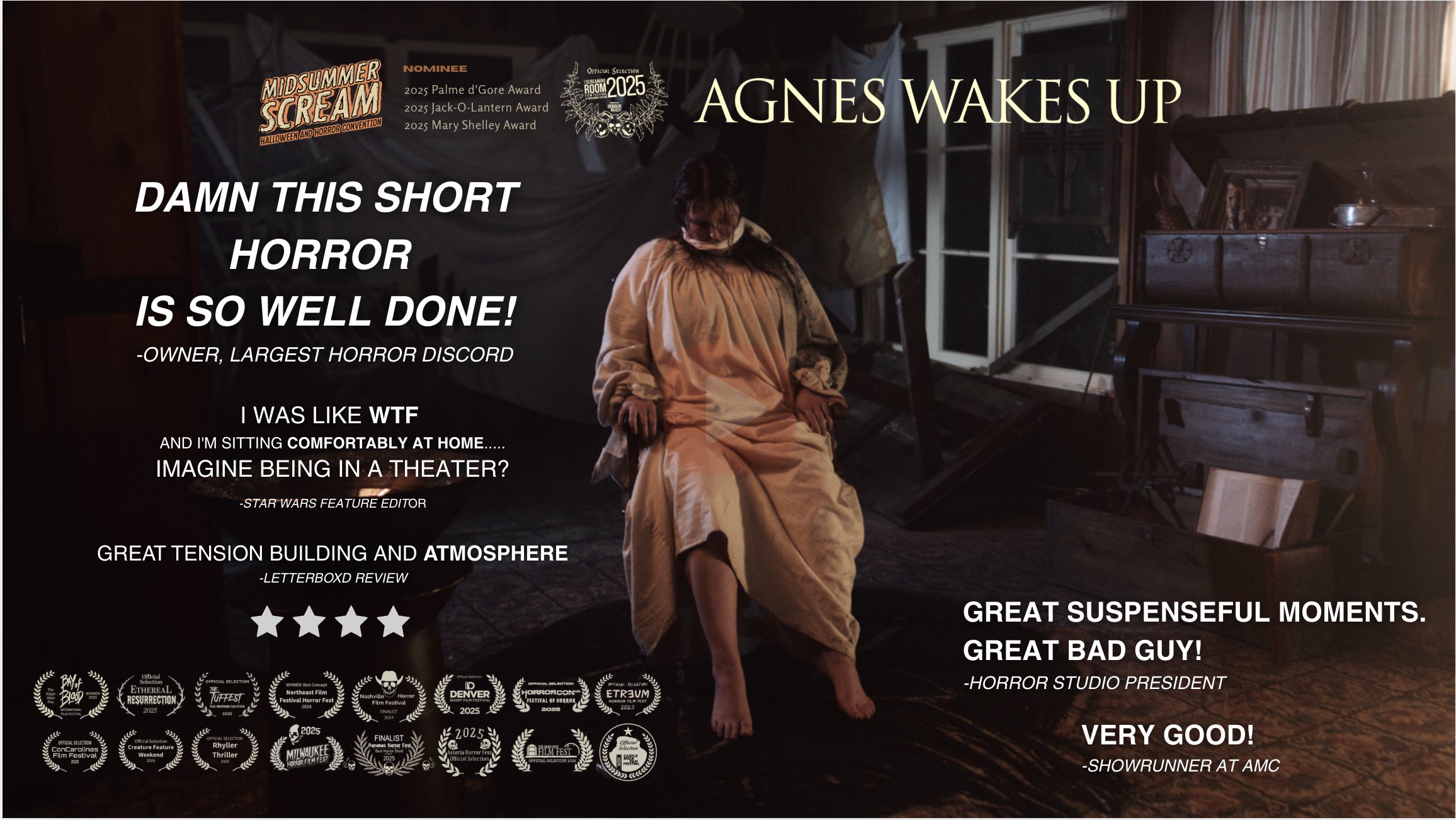
Agnes Wakes Up · Writer, Producer, Director
Studio-minded horror craft on an independent budget.
I wrote, produced and directed the short for $12,000. It went on to more than 30 festivals, three wins and ten placements, giving me a practical test of what careful preparation and genre knowledge and craft can accomplish on an independent budget.
$12KBudget
30+Festivals
3Wins
10Placements
$1M–$5M reported budgets · 1,000+ theaters · 2003–2026
16.31×Median Return
21.85×Average Return
433 theatrical horror releases tested
The complete source dataset is transparent and downloadable. Open the calculator for full access.
Interactive Finance Tool
Horror Returns.
Test the assumptions instead of taking them on faith. I built the calculator to show how budget, acquisition terms, distribution expenses, recoupment and the producer-side waterfall change what may reach an investor.
The complete 433-film dataset, covering every theatrical horror release from the past 26 years, including all independently financed titles, is transparent and available to download.
Case Study · Tech × Film
Technology is my first language.
I use technology to make complex work clearer, faster, and more dependable, protecting the creative process and supporting people. The best systems remove friction so crews can focus on the work only they can do.
The instinct started early.
I was using computers before I could walk. As a kid, I built hovercrafts and took apart RC cars. A public-school robotics mentorship in fourth grade laid the foundation for my middle-school science fair project: an autonomous ground robot -- like a Roomba, but without the cleaning. At the same time, I was the school webmaster, helped teach web design and built websites. In high school, one of those projects led to a job at Nielsen. In college, technology I developed during a marketing internship turned the internship into an extended engineering position. I also worked as an IT technician for a company serving 400+ clients. Before discovering entertainment, I ran cloud technology and servers.
The same instinct, applied to production.
When I moved into film and television, I brought that same systems mindset with me. I introduced country-based cast schedule tracking, created cloud tools that let entire productions coordinate meals (still duplicated and used by productions to this day), automated supply tracking so departments could stay stocked, managed Scenechronize administration and distributed advanced production documentation. I also oversaw the technology packages used to launch new production offices. These systems reduced repetitive work, prevented avoidable problems and helped crews operate more smoothly under demanding production schedules.
Created video deliverables technology that expanded education.
At Word Dog, a funded technology and entertainment startup I co-founded, we built scalable video assembly and distribution technology that expanded access to engaging language education for tens of thousands of learners. By splitting a source video into different deliverables and versions, we deployed 1200+ videos and had the capacity to multiply 100 source videos into 245,000.
During this process, I created 12+ tools, prototyped, edited and built source videos, automated splitting and conforming the production data so it could speak to our servers, and built FFmpeg pipelines to modify and assemble videos. I partnered on designing workflows and scaling, in which creative and cultural judgment, human translation, voice performance and technical precision worked together reliably at enterprise levels.
Promoted twice to top Motion Picture Advisor.
Most recently, under NDA, I advised a pre-IPO aerospace and emerging-technology company -- one of the world’s ten largest private technology companies. Within two months, I was promoted twice from a pool of 100+ global experts to its top Motion Picture Advisor position. I reviewed experts’ work, advised on the ethical direction of film technology and was one of five retained through project completion. My top performance was partly driven by a bespoke tool I built and shared, increasing efficiency by 15%. I also completed a company-wide, 48-hour hackathon using an unreleased AI coding technology and delivered a finished product despite competing solo against a field made up mostly of teams.
The same product thinking shapes ongoing projects: the calculator embedded on this site, and the accessibility-first scheduling SaaS I designed to handle complex scheduling in the fewest possible clicks.
Across every chapter, the throughline is the same: I understand technology deeply, translate it across disciplines and apply it in ways that make ambitious creative work more achievable for everyone involved.
Industry Sphere
Across the table.
Filmmakers, producers, actors and teams I’ve worked with, developed with, or share projects with. Randomized. Drag to rotate.
Lana WachowskiKnown for The Matrix · Cloud Atlas · V for VendettaShared Sense8 · Jupiter Ascending · The Matrix Resurrections
Lilly WachowskiKnown for The Matrix · Cloud Atlas · V for VendettaShared Sense8 · Jupiter Ascending
Tom TykwerKnown for Run Lola Run · Cloud Atlas · Sense8Shared Sense8
J. Michael StraczynskiKnown for Babylon 5, World War Z, Thor, Underworld: AwakeningShared Sense8
Bae DoonaKnown for The Host, Cloud Atlas, KingdomShared Jupiter Ascending, Sense8
Jamie ClaytonKnown for Sense8, The L Word: Generation Q, HellraiserShared Sense8
Tina DesaiKnown for Sense8, The Best Exotic Marigold Hotel, Thomas & FriendsShared Sense8
Tuppence MiddletonKnown for Downton Abbey, The Imitation Game, War & PeaceShared Sense8
Max RiemeltKnown for Sense8, Berlin Syndrome, The WaveShared Sense8
Miguel Ángel SilvestreKnown for Sense8, Money Heist, VelvetShared Sense8
Brian J. SmithKnown for Sense8, Stargate Universe, TreadstoneShared Sense8
Aml AmeenKnown for The Maze Runner, Sense8, I May Destroy YouShared Sense8
Toby OnwumereKnown for Sense8, The Matrix Resurrections, Empire of LightShared Sense8, The Matrix Resurrections
Naveen AndrewsKnown for Lost, Sense8, The English PatientShared Sense8
Daryl HannahKnown for Blade Runner, Kill BillShared Sense8
Freema AgyemanKnown for Doctor Who, Sense8, New AmsterdamShared Sense8
Terrence MannKnown for Sense8, Critters, FoundationShared Sense8
Anupam KherKnown for Silver Linings Playbook, Hotel Mumbai, The Big SickShared Sense8
Alfonso HerreraKnown for Rebelde, OzarkShared Sense8
Eréndira IbarraKnown for Sense8, The Matrix Resurrections, IngobernableShared Sense8, The Matrix Resurrections
Alex BodenKnown for Tokyo Vice · Cloud AtlasShared Sense8
Roberto MalerbaKnown for V for Vendetta · SpectreShared Sense8, Cortés
Loranne TurgeonKnown for Unforgiven, In the Line of Fire, The Matrix ResurrectionsShared Sense8, The Matrix Resurrections
Keanu ReevesKnown for The Matrix, John Wick, SpeedShared The Matrix Resurrections
Carrie-Anne MossKnown for The Matrix, Memento, Jessica JonesShared The Matrix Resurrections
Yahya Abdul-Mateen IIKnown for Aquaman, Watchmen, CandymanShared The Matrix Resurrections
Jonathan GroffKnown for Hamilton, Frozen, MindhunterShared The Matrix Resurrections, Looking S2
Jessica HenwickKnown for Game of Thrones, Iron Fist, The Matrix ResurrectionsShared The Matrix Resurrections
Neil Patrick HarrisKnown for How I Met Your Mother, Doogie Howser M.D., Gone GirlShared The Matrix Resurrections
Jada Pinkett SmithKnown for The Matrix films, Girls Trip, GothamShared The Matrix Resurrections
Priyanka Chopra JonasKnown for Quantico, Citadel, Bajirao MastaniShared The Matrix Resurrections
Christina RicciKnown for Casper, The Addams Family, Yellowjackets, Speed RacerShared The Matrix Resurrections
Grant HillKnown for Titanic, The Tree of Life, The Matrix Sequels, Cloud AtlasShared Company Slate, A Hidden Life, The Matrix Resurrections, etc.
Bruce BermanKnown for Village Roadshow Pictures · The Matrix franchise · Ocean’s ElevenShared The Matrix Resurrections
Terrence MalickKnown for The Thin Red Line · Days of Heaven · The Tree of LifeShared A Hidden Life
August DiehlKnown for Inglourious Basterds, A Hidden Life, SaltShared A Hidden Life
Valerie PachnerKnown for A Hidden Life, The King’s Man, Fantastic Beasts: The Secrets of DumbledoreShared A Hidden Life
Marcus LogesKnown for The Queen’s Gambit · TárShared A Hidden Life, Sense8
Mila KunisKnown for Black Swan, That ’70s Show, Family GuyShared Jupiter Ascending
Channing TatumKnown for Magic Mike, 21 Jump Street, FoxcatcherShared Jupiter Ascending
Eddie RedmayneKnown for The Theory of Everything, Fantastic Beasts, Les MisérablesShared Jupiter Ascending
Sean BeanKnown for The Lord of the Rings, Game of Thrones, GoldenEyeShared Jupiter Ascending
Steven ZaillianKnown for Schindler’s List · The IrishmanShared Cortés
Javier BardemKnown for No Country for Old Men · SkyfallShared Cortés
Diego LunaKnown for Andor, Rogue One, Y Tu Mamá TambiénShared Cortés (Executive Producer)
Gael García BernalKnown for The Motorcycle Diaries, Babel, Mozart in the JungleShared Cortés (Executive Producer)
Andrew HaighKnown for 45 Years · All of Us StrangersShared Looking
Murray BartlettKnown for The White Lotus, The Last of Us, LookingShared Looking S2
Wong Kar WaiKnown for In the Mood for Love · Chungking ExpressShared Tong Wars
José PadilhaKnown for Narcos · Elite Squad · RoboCopShared The Condor Years
Mike CruzKnown for Beast Games, MrBeastShared Keanu × MrBeast Charity Video Dev
Jeff BuhlerKnown for Pet Sematary, The Prodigy, NightflyersShared A Christmas Carol
Felipe & João PradoKnown for Elite Squad · The MechanismShared The Condor Years
Dennis DavidsonKnown for Founder · DDA GroupShared Elizabeth Bay Slate Development
Leifur DagfinnssonKnown for The Northman · Black Widow · Mission: ImpossibleShared Sense8
James McTeigueKnown for V for Vendetta, Ninja Assassin, The RavenShared Santa Lost Down Under
Bill KinderKnown for Pixar Editorial (Founder)Shared Santa Lost Down Under
Kimble RendallKnown for Bait 3D, I, Robot, The Matrix ReloadedShared Age of Beasts
Kathryn BigelowKnown for The Hurt Locker, Zero Dark Thirty, Point BreakShared Triple Frontier (Prior Development / Professional Contact)
Charles “Chuck” RovenKnown for Oppenheimer, The Dark Knight Trilogy, Wonder WomanShared Triple Frontier (Prior Development / Professional Contact)
Andrew BlazenskyKnown for Looking, Chasing Mavericks, Paramount, Magnum P.I.Shared Agnes Wakes Up, Blackfossil
Lina LeikamKnown for Agnes Wakes Up, Superman, The Alto KnightsShared Agnes Wakes Up
Will PionkeKnown for Power Book IV · Sense8 · Delhi Boys · The Matrix ResurrectionsShared Sense8, The Matrix Resurrections
Hugh BateupKnown for The Matrix films · Cloud Atlas · Speed RacerShared Sense8, The Matrix Resurrections
Terry NeedhamKnown for Gladiator · Children of Men · V for VendettaShared Cortés, The Matrix Resurrections, Sense8
REFERENCES
Letters of Reference
Three views of how I work: from the producer who trusted me to lead development, a production colleague who saw me under pressure and a collaborator from my independent directing work.
From leadership
I’ve built success by surrounding myself with remarkable individuals. Among them is Neil Chestnutt… Bright, affable and very keen to make projects work, Neil was the ideal person to lead my creative department… I give him and his projects my full support and recommendation.
GHGrant HillProducer of Titanic, The Thin Red Line, Cloud Atlas and The Matrix sequelsLetter of Recommendation, 2024Read full letter →
From production
Neil proved himself to be exceptionally capable, reliable and efficient… His sensitivity, diligence, energy and sense of humor made working with him a joy. In my estimation, Neil would be an asset to any institution, organization or business.
LTLoranne TurgeonAssociate Producer · Unforgiven, Sense8, The Matrix ResurrectionsLetter of Recommendation, 2014Read full letter →
From set
Neil comes in highly prepared, thinks ahead, and keeps the bigger picture on track even when things get unpredictable. He creates a professional, collaborative atmosphere where everyone feels trusted to work, try things, and bring their best creative ideas forward.
LLLina LeikamSFX Makeup Artist · Superman, The Alto Knights, Agnes Wakes UpLinkedIn Recommendation, 2026Full review on LinkedIn
Further references on request
Bryon Mathias-Fuqua · Co-Founder, Word Dog · Video Distribution Technology
On RequestJosé Padilha · Director / EP · Elite Squad, RoboCop, Narcos
On RequestEmma Mason · VP International Marketing & Publicity · Mister Smith Entertainment, Vice
On RequestFelipe & João Prado · Directors / Producers · The Mechanism, Elite Squad 1 & 2
On Request